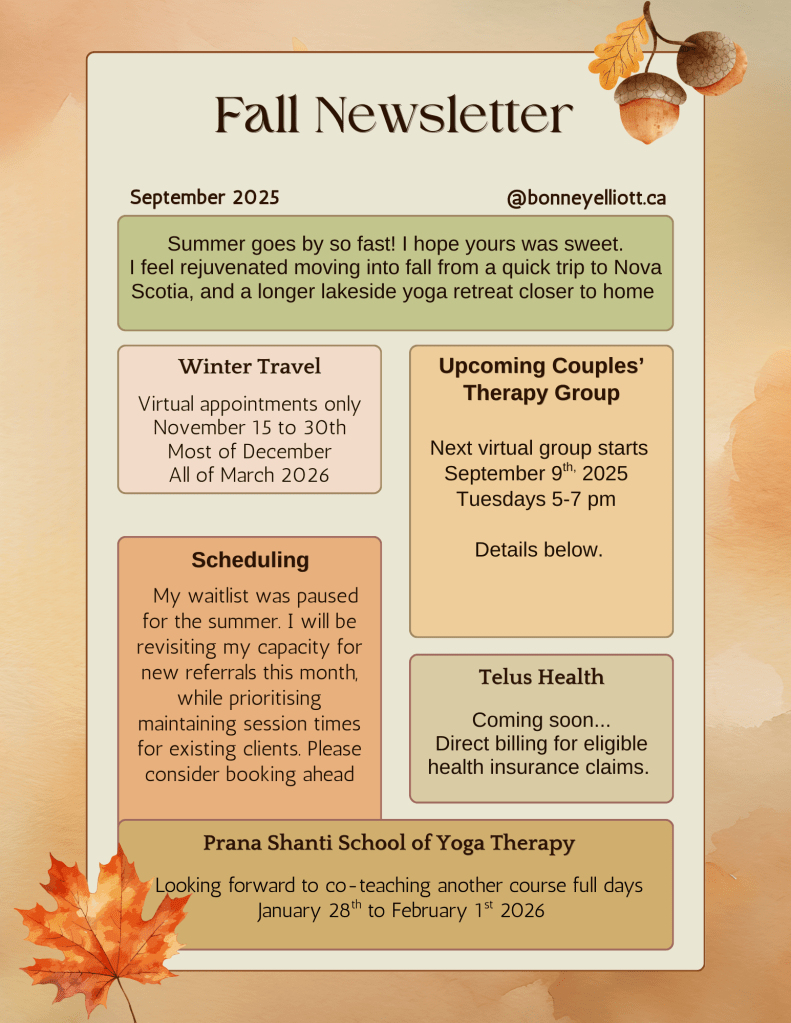
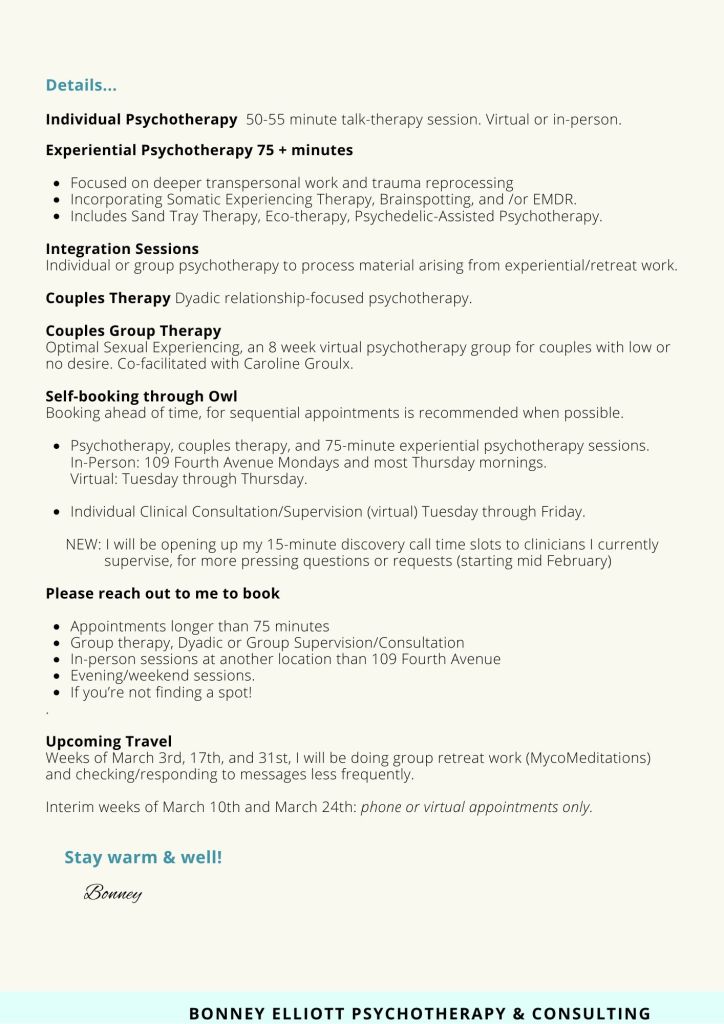
Booking virtual appointments only from December 9-31. Out of office December 24-26 and January 1. Working fewer hours Dec 22-23 and 29-31. Reach out if you are having any trouble booking online.
Direct Billing
Direct billing is now available for plans with many insurers, including Blue Cross, Canada Life, Manulife, Coughlin, and Desjardins. Sunlife is coming on board in December. Please note, that I cannot direct bill for OTIP or Green Shield, or services billed under a supervising psychologist.
Climate Grief
2025 has seen heartbreaking weather events around the world, with a rise in eco-anxiety and climate grief. This hit home personally, when Hurricane Melissa ravaged the area of Jamaica I would have travelled to this month for retreat work. It will take months to restore infrastructure to parts of the island. I am grateful for the outpouring of support and relief efforts underway. For those inquiring about a reputable charity to donate to, World Central Kitchen is a great option. They work feet on the ground in collaboration with local chefs and restaurants.
Playing in the Sand
These winter months are a natural time to slow down, for deeper reflection. Sand Tray Therapyis a powerful adjunct to ongoing psychotherapy, clinical supervision, or psychedelic integration. I had fun this November revamping the array of miniatures, objects found in nature, and art materials that I keep on hand for this experiential work. Let me know if you are interested in learning more about sand tray therapy or booking a session or workshop. Please note these need to be booked in advance and held in-person.
Every January, I choose a theme or a word to pay attention to in the coming months. Last year, given the impact of the pandemic, I focused on Connection. In 2022, I want to take a deeper dive into the concept of Power.
Why power? Because there are simply too many things happening in the world right now that feel beyond our control. This can lead to a roller coaster of emotions of heightened anxiety, defensiveness and numbness associated with the fight-flight-freeze response. Feeling disempowered can have a significant impact on our well-being and the health of our relationships.
Power is not a neutral word. It can bring up both strong negative and positive associations. I am curious about how our personal, collective and intergenerational experiences with power colour our perceptions of ourselves and others.
I want to better understand what it truly means to empower. To find that sweet spot of influence over our circumstances that lies somewhere in the middle ground of the continuum between absolute power over and utter helplessness.
In its positive aspect, power is a vital force for action and change. I want to explore the embodied nature of power. To know where we get it from and how it flows through us. I want to be able to recognize healthy, dynamic power, while noticing the the ways in which its energy can become blocked, twisted or diverted.
What does the word power bring up for you? How does it show up in your relationships?
The soundtrack of the Nutcracker Suite, playing as I write this. I could listen to the album at any time of year, but it would not be the same. I close my eyes and remember the hush of the National Arts Center when the red velvet curtains part and the orchestra starts up. Wide eyed children settling into their seats to watch the story of Clara unfold. Thank you, Tchaikovsky for your brilliance, and to whoever invented ballet. Such a beautiful way to move and express the emotions that are evoked by inspiring music.
Snowbursts. Occasionally during the right atmospheric conditions in December, snowflakes clump together as they fall from the sky, carpeting every surface with feather light, glistening megaflakes. These conditions are not so great for driving, but walking outside during that kind of snowfall is magical. Like being inside a snowglobe.
Blooming houseplants. On stormy days I feel restless indoors. With the garden having been long put to bed, I derive simple pleasure from the flowering Christmas cactus and elegant orchids given to me by people I care about. The lush poinsettia sitting proudly on the sideboard is a more transitory visitor, an exotic December novelty.
Evergreen trees. Now that the deciduous trees have finished their fall display, it is the fir trees’ time to shine. Nothing compares to being in the forest after a snowfall and inhaling deeply. We bring some of the woods indoors with fresh pine boughs and the proud spruce tree twinkling with lights that mirror the moon and stars outside. The house sealed up stale and close for winter smells more alive.
Christmas angels. The human ones, who are out there doing good deeds at this time of year. And the thrill of reconnecting with the ornamental ones, that have been tucked away carefully all year wrapped in tissue paper in a special box. My Mum’s name was Angeline (Angie). Over the years I have collected angel decorations that remind me of her kindness and her love of Christmas. These angels comfort me, and connect me to her memory. Setting up the manger scene reminds me of going to Mass with her at Christmas time, and of how the simple story of the Nativity deeply moved me as a child.
Anglo-Saxon traditions. My lineage is Scottish/Irish/English. It would be sweet some day to spend a Christmas season in the UK. Edinburgh would be particularly magical at this time of year. In the meantime, it feels grounding to mindfully incorporate some of the traditions of my ancestors. Mistletoe hung in the entranceway. Wreath on the door. A wee dram by the fire on Christmas Eve. Auld Ang Syne and Hogamany on the 31st. The Victorians sure did up the holidays in a big way.
T’was the Night Before Christmas. I wholehearted plunged into that story/poem as a child, and still experience the magic and wonder of Christmas Eve. It reminds me of my children’s Santa, their kind grandfather who was a lover of songs and stories and of Christmastime.
Dickens Village. Setting up the Christmas village and the tiny human figures carolling and playing in the snow reminds me of more than my Anglo-Saxon heritage. They call to mind memories of my brother-in-law who loved Christmas and poured heart and soul into making holidays special. George was an integral part of my Christmas from when I was just four years old, as was his father, who was the Santa of my childhood.
Learning about other traditions. December is a nice time to connect with people around other cultural and religious celebrations that happen at this time of year, such as Hannukah, Kwanza and Orthodox Christmas. The solstice has become a particularly sacred time for me. A day of reflection and peaceful connection to the night sky and something bigger than myself amidst the hustle and bustle of holiday preparations and get-togethers.
Nice meals. I no longer pull out all the fancy fixings that my grandparents feted the holidays with. Turkey and stuffing, fruitcake and rum soaked pudding all feel like too much for one day. Instead, we spread the holiday out over the twelve days of Christmas and make special communal, not always traditional meals that we might not have time to put together during the rest of the year.
Gingerbread. Normally, I feel lukewarm about baking. All that messy flour and precision measuring and rolling. I would rather cook with abandon. But I have to say there is something comforting about creating and decorating little spicy gingerbread people. It feels quite satisfying to dip them into a steamy cup of tea and bite off their heads.
Chocolateand tangerines. In my parents’ youth, wartime rations made the appearance of these treats at Christmas time especially dear. Now, we can eat them at any time of year, but they seem particularly decadent iand delicious during Advent. Making chocolate truffles has become a holiday ritual.
Quality time with family & friends. This is my favourite thing about December, rendered all the more precious with the separations of the pandemic. The anticipation of seeing people I love over the holidays makes my heart smile.
There are many words to describe the emotions associated with this time of year, including nostalgia, longing, joy, fun, wistfulness, heartache, love, and connectedness. The feeling state that best captures December for me is that of Wonder, in all its forms.
I wish you and yours a wonder-full holiday season !
November is not an easy month. It is a time of gathering darkness and bracing for the cold starkness of winter. For reflection, and grieving of people, places and parts of our lives we have lost and left behind. Of feeling tired and out of sorts, physically depleted and more susceptible to illness. It is easy to fall into the habit of resenting this time time of year. Slogging through or wishing the time away while daydreaming of spending the month on a tropical island somewhere. Life is too short for that.
Here are simple tips for leaning into rather than enduring November:
Curl up with your inner grizzly. If the demands of the season have you feeling overwhelmed, keep in mind that we humans are essentially hairless bears. Fighting the urge to slow down when the days get shorter and colder makes us irritable and vulnerable to illness and depression. Modern life may not lend itself to hibernation, but are there ways to retreat. Get cozy and sleep a little longer, nap when you can. Lower your expectations and trust that energy and productivity will return when the days start to lengthen.
LIsten to your body. Notice when you are feeling run down and take action. Decide whether your immune system needs a little TLC or some radical self-care, Letting someone who cares know that you are not okay is taking action. So is taking time off work or booking a holiday or a massage. Or asking for help.
Remember your lineage. Observe All Soul’s Day, the Day of the Dead or Remembrance Day as opportunities to explore family history. Ask about your uncle who served in the war. Go through old family photos. Listen to the music that your parents and grandparents grooved to. Visit a cemetery and honour the dead.
Spend time in nature, The landscape may look gray and bleak but there is a stark beauty to November. Bundle up and get outside when you can. Turn your face towards the sun. Breathe deeply.
Revitalize your hobbies. You may lack the energy and the motivation to make decisions or plunge into a project, but November is a great time to contemplate setting into motion activities that will make the winter months more enjoyable. Order that book, look into a class, or do a quick inventory of your craft materials so that you will have what you need later.
Connect with memories. Without ruminating, take stock of your life. Are there people you want to make more time for? Relationships that need tending or mending? Unprocessed grief that wants expression? Trauma or drama that you’d prefer not to carry into the new year? Joyful memories of vacations and events that you want to make sure to keep alive?
November is challenging, but when experienced consciously serves an important purpose. November forces us to slow down, reflect, and make meaning of the past, clearing the way for fully experiencing the holidays and the year ahead.
Please remember to stay cozy, think like a bear, and listen to your body.
A year of connection would not be complete without a post on shyness. In my writing group, this week’s prompt was to start with the words “How to” Here it is:
Merriam Webster defines shy as: “1. Being easily frightened, timid. 2. Disposed to avoid a person or thing. 3. Hesitant in committing oneself. 4. Sensitively diffident or retiring. 5. Secluded, hidden. 6. Having less than the full or specified number”. Synonyms include bashful, coy, demure, diffident, introverted, modest, retiring, inhibited, and reserved. Antonyms include adventurous, bold, daring, brash, gutsy, confident, and self-assured.
While true at face value, these black and white definitions fail to capture the broad spectrum, the nuances, or dare I say the gifts of shyness. “Shy” is described as a fixed construct, a state of being. As a person who can well identify with the experience of shyness, I too have succumbed to the social narrative of shyness as a static, limiting character flaw. A painful affliction stemming from innate temperament, a product of early childhood experiences, or some combination of both. Something to be “gotten over” and “grown out of” to fully experience life.
Not true. I believe that viewing shyness as a deficit to be overcome is the wrong approach. I want to shift the dialogue from shyness as a state of being to talking about shyness as a physiologic response. A valid set of visceral sensations and emotions that arise to protect and preserve when a social experience feels unfamiliar, uncomfortable, and/or potentially unsafe. Pushing down shyness and soldiering through inhibits the full action-taking of the response. Taking the time to experience and reflect on what is actually happening when we feel shy can yield powerful insights and a deeper capacity for empathy.
I propose that rather than pondering the question “why am I shy?”, we ask ourselves:
When do I feel shy?
What happens in my mind and body when this feeling of shyness appears?
What parts of my psyche feel shy?
What parts feel something different than shy? Bold, expressive, brave, neutral….?
What is this feeling of shyness trying to tell me about what I need in this situation?
How does this feeling of shyness shift when I give words to it?
The easiest way to illustrate these is a personal example. I tend to feel shy at loud, crowded social events where relative strangers stand around in random groupings and make small talk. Especially when I feel the pressure of a social or work role to “network” with said strangers. (I have not missed those occasions through Covid)
When shyness appears, several things happen in my body and mind. I take longer to make basic decisions such as what to wear and how to get to where I am going. I procrastinate. I experience muscular tension in body locations such as my jaw and upper chest. My hands feel restless, my mouth dry. My senses seem heightened, and the room feels louder and hotter than it is. Usually, these feelings subside once I get acclimatized to the space and feel some sense of genuine connection with, and coherence amongst the group. Occasionally, in situations where there is little such affiliation and a high degree of tension and competitiveness in the room, my nervous system can become quite overloaded. I get through the event in a kind of survival mode, a state of overwhelm that takes a great deal of energy and leaves me exhausted afterwards.
There are parts of me that tend to feel shy in new social situations, and other parts that do not. I have a strong adaptive part that gets confused when there are too many new people to relate to all at once. A perfectionist part that would rather come across as reserved than socially inept. A self-critical part that tells me to just get over it. An avoidant part that dithers and procrastinates while a rebellious part plans a dramatic protest. A deeply hidden vulnerable part that fears social judgment and outcast. A catastrophic part that assumes the butterflies of shyness will escalate into a complete meltdown unless the situation is carefully managed. With all these competing interests and desires, no wonder my nervous system feels overloaded in certain situations. Fortunately, not all my parts are held in the grip of shyness. There is a social part that quite enjoys meeting new people, a curious part that wants to learn and grow, a self-expressive part that shows up to see and be seen, and an enterprising part that embraces the opportunity to explore new possibilities.
So, what are these aspects of shyness trying to tell me about what I need in these situations? How do I work with all the moving parts? The first step is to connect with them, hear what they have to say. I discover that they all exist for a reason, the survivalist parts protecting the more vulnerable ones like a set of nested dolls. The adaptive part asserts that harmony is important. It needs to get the lay of the emotional landscape before speaking up in a new social setting. The perfectionist part needs time to warm up, to shake off the fear of making a dreaded social faux pas. The self- critical part needs to feel accepted. The avoidant part needs to commit to a plan of action. The rebellious part needs to be heard and have a plan B. The vulnerable part needs witnessing. The catastrophic part requires proof that moments of shyness are not symptomatic of some deeper pathology. The hands want to move freely and express themselves. The muscles that are braced want to laugh off the tension and receive the oxygen that comes with a deep, unrestricted breath.
When I give words to the parts that make up my felt experience of shyness, something shifts. Tears of compassion well up. How harshly I have judged myself over a lifetime for simply feeling shy at times. My jaw softens into a small smile. I reflect on beautifully “shy” versions of myself and others whose moments of shyness are part of their charm. My restless hands come together in stillness and solidarity. I breathe in the realization that feeling shy is rarely about not wanting to connect with people or try new things. It is about longing for authentic connection with self and others. Getting past the superficial small talk.
A flash of anger towards well-meaning people who have pushed me to overcome shyness morphs into feeling empowered. Why not rock shyness instead? Embrace and accept its gentle gifts.
In this year of focus on connection, I find myself wondering why we humans get so attached to things. Why do we find, collect, hang onto and attach meaning to physical objects ? Why some things and not others? How do our feelings get projected onto our stuff? Nostalgia for the past and aspiration for the future. Love and loss. Pain and pleasure. At what point does a healthy attachment to material possessions morph into materialism? Where is the fine line between collecting things and hoarding them? I have no definitive answers to these questions, but looking from the perspective of the different energy centres of the body may shed some light on our connections to things.
The root chakra is about connection to ancestry, tribe, and the earth itself. We attach to things that we feel we need to survive, and stuff that reminds us of our corners of the world and where we come from. Do your treasured possessions add to your sense of belonging and groundedness? Do they truly speak to your culture and your roots? Are you hanging onto memorabilia passed down from ancestors that no longer serves you or brings you joy ? It may be time to dust off the objects you feel truly rooted to, and repurpose or pass along things that are simply taking up space.
The sacral chakra is about connection to our emotions and with the emotions of others. Our centre of sexual and creative energy. The place from which we create and find beautiful, evocative things that bring joy and pleasure. Is your stuff a true reflection of your inner world? Are your most precious and beautiful belongings hidden away or displayed? Are they all but lost in the clutter of too many things? Do you hold back on fully expressing yourself through the clothes you wear and the decor of your surroundings, choosing function over form and muted colours and practical pieces over fun ones?
The solar plexus chakra is about connection to trust and power. We collect objects that signify comfort and securtiy, as well as acheivement and social status, from our cozy favourite sweaters to the gilded diplomas on the wall to the new car in the driveway. Most of us have things we have acquired and hung onto because of their material value, or to project a certain image. Do your posessions help you feel safe and secure? Confident and in control? If your desire for shiny objects far surpasses your need for them, it may be worth taking the time to evaluate the authenticity of your relationship to material things.
The heart chakra is our connection to love and compassion. We get attached to things that are gifted to us, and pictures and objects that remind us of those we love. We displace our love for people onto things sometimes, like a child clings to their favourite blanket. Over a lifetime of love and loss, stuff accumulates and it can be difficult to part with. Ask yourself whether you are keeping things for love or simply nostalgia. Sometimes we hold onto things because actually touching them feels too painful, such as the heartache of going through that box of a deceased loved one’s possessions, or rereading an old love letter. Bringing awareness to the the emotional charge we attach to objects can be healing..
The throat chakra is about communication and speaking our truth. We stay connected to things that tell the stories of our lives: words we have written and books we have read, pictures of places we have been and maps of places we want to visit. Documents and objects marking important life passages. Have you grieved the loss of key pieces of your story to moves, theft or fire? Do the things you have managed to hold onto reflect your personal narrative? How do you want to be remembered?
The third eye chakra is the seat of consciousness, our connection to wisdom and the present moment. We are drawn to things that help us learn and grow, and tap into intuition and deeper levels of consciousness. Do the objects you collect actually reflect your life as it is now? Some of our collections are like time capsules frozen in the past or hope chests for futures we are not actively creating.
The crown chakra is our connection to all that is and the dissolution of the myth of separateness. At the end of the day, all of our connections to objects are temporary. Things get lost and broken. They eventually fall apart. We no longer need them and pass them along to someone else, or give them back to the earth. Do you look at objects that come into your hands with a sense of possession? “This thing is mine and I am keeping it”. Are you willing to share your things with others or give stuff away to those in need?
This summer, I plan to look at my relationships with physical objects through more discerning eyes. Keep the things that are useful, treasured and meaningful, and start to let go of things that no longer belong to the life I am living.
Mixed emotions arise as our province and country start to open up again from Covid-induced lockdown. Relief about dwindling case counts and accelerated vaccination rates. Grief around multiple losses. Hope about returning to some kind of normal. Fear that “normal” will be fleeting. Excitement about in-person events and activities. Anger and Despair about the inequities exposed and highlighted by this pandemic. Yearning to reconnect with faraway people and places. Concern that climate change will be a lower priority.
Let’s reconnect with kindness, and remember to:
Celebrate life passages such as birthdays, weddings and graduations with gusto, while bringing into community the losses experienced in isolation, without proper goodbyes and collective rituals of mourning.
Reconnect with the ones we love, while taking the time to talk about the grannies, grandpas, parents, aunts, uncles, siblings, children, and friends who died alone during Covid and from Covid.
Embrace the freedoms that come with a second jab, while staying humble to the privilege. Much of the world is not yet vaccinated.
Fill our hearts with the joy of being with children, while extending support to their exhausted parents and teachers.
Spend precious time with the elderly, while honouring the long term care staff who have been there for them.
Live life to the fullest, while recognizing the cracks in our social fabric, and reaching out to those struggling with the ongoing economic, psychological, political and health impacts of the pandemic.
Resume the joy and adventure of travel, while doing what we can to minimize the impact on the environment.
Resume social activities while giving each other time to adjust, relearn social skills, and figure out individual comfort levels with physical proximity and larger gatherings.
Reconnect with the external world without losing hard won connections to our inner worlds through this introspective time. Maybe we do not have to rush back to crazy schedules or push through introversion, shyness or social anxiety.
Enjoy the physical activities we have been missing without judgement about diminished fitness levels and Covid weight gain.
Balance fear with hope as we navigate the uncertainty of future outbreaks.
“Embodiment is living within, being present within the internal space of the body. It’s something quite different from being aware of the body”
Judith Blackstone
As I integrate Somatic Experiencing Therapy into my practice, I find myself wondering what it would feel like to live a more fully embodied existence. There are glimpses, while doing yoga, dancing, gardening, hiking through a forest, creating… whenever I am completely immersed in an experience. I feel most embodied by the ocean, toes in the sand, wind in my hair, as the surf rises to meet me. I feel more alive when mind and body are connected. In touch with my emotions and physical sensations. Able to tap into and trust my intuition. Life flows, and there is a sense of timelessness. I have more energy and passion for living. Embodiment is being in the body, and we all have our own ways of getting there.
On busy days I feel like I spend far too much time “in my head”, thinking and planning. Not exactly “disembodied”, but definitely living at more of a distance from my physical experience than I would like. Working for hours sitting in front of a computer screen, taking my body for granted until it starts talking to me, often in the form of exhaustion, muscle tension or eye strain, or feeling restless and irritable, at odds with myself. Does this sound familiar to you?
A simple practice I have discovered to quickly shift from thinking to experiencing is to bring in an element or a combination of elements of earth, wind, fire or water. Here are some suggestions for finding moments of embodiment in the day-to-day busyness of life through exploration of these four elements:
Earth: If you are feeling scattered or unfocused, take a moment to ground into the earth element. Simply feel the contact of your feet on the floor. Allow yourself to sink more deeply into the pull of gravity. Look around the space you are in and set your gaze on a plant or a flower, or a picture of a forest or a mountain. Touch something solid or hold a smooth stone in the palm of your hand. Wrap yourself in something soft and heavy, maybe even a weighted blanket.
Wind: If you are feeling stuck and stagnant, bring in the element of air. The simplest way to do this is to take a deep breath. Notice the inner tumbling of your thoughts and worries, and detach from their grip by looking at the sky, turning on a fan, or opening a window to let the breeze in. Take a moment to stretch and yawn and move your body in a way that feels good. Connect with a song or a poem.
Fire: If your energy is flagging, access the element of fire. Turn towards the sun or a source of heat and light in the space you are in. Light a candle and gaze at the flickering flame. Warm your palms with the heat of your breath, by rubbing them together, or wrapping them around a steaming cup. Bring that warmth to wherever your body feels stiff or cold, or simply place your hand over your heart and connect with its rhythm. Think of hugging someone you love and imagine their warmth and energy enfolding you.
Water: If you are taking on the stress and emotions of your environment, connect to the soothing, releasing element of water. Take a sip of liquid. Slow down for a moment. Close your eyes and feel your feelings. Imagine yourself floating in your favourite body of water, or dancing in the rain. Bring some humidity into the air around you. Wash your hands. Take a moment to moisturize your skin or your lips.










 Bonney Elliott